
How to Treat CNC Coolant Contamination: Choosing Equipment for Fines, Tramp Oil, and Sludge
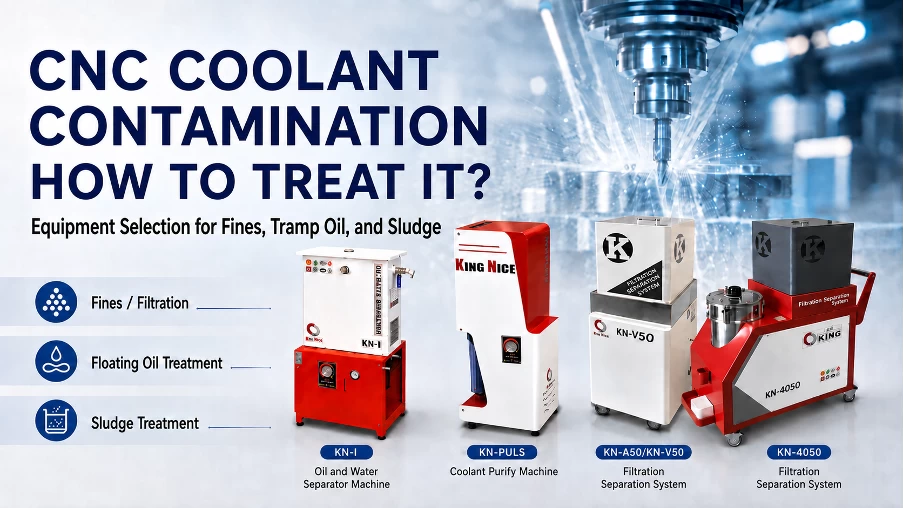
CNC coolant contamination should be treated according to the type of contaminant present. Metal fines, grinding particles, graphite powder, and other solid contaminants require centrifugal separation or filtration. Slideway oil, hydraulic oil, and other floating oils require oil-water separation. Chips and sludge that have already settled at the bottom of the tank need to be removed separately.
At KingNice, we first identify where the contamination is located, what form it takes, and what machining conditions are involved before recommending the appropriate treatment equipment.
What Types of Contamination Are Common in CNC Coolant?
Different machining processes generate different contaminants. Before selecting equipment, first determine whether the problem is in the coolant, on the surface, or at the bottom of the tank.
| Contamination Problem | Common Contaminants | Recommended Treatment |
|---|---|---|
| Fines and fine particles in machining fluid | Metal fines, grinding powder, graphite powder, ceramic powder, silicon powder | Centrifugal separation or filtration |
| Floating oil on the coolant surface | Slideway oil, hydraulic oil, lubricating oil, and other tramp oil | Oil-water separation |
| Deposits at the bottom of the tank | Larger chips, settled solids, and sludge | Chip and sludge removal |
These contaminants require different treatment methods. An oil-water separator cannot replace a fine-particle treatment system, and a centrifugal separator is not designed to remove floating oil from the coolant surface.
How Should Large Amounts of Fines or Fine Powder Be Removed from Coolant?
Grinding, graphite machining, ceramic processing, glass processing, and some metalworking operations can generate large quantities of fine solid particles. These may include metal grinding fines, graphite powder, ceramic powder, glass powder, silicon powder, aluminum fines, and stainless-steel particles.
Once these particles enter the machining fluid, they can continue circulating with the coolant. When solid fines or powder are the main contaminants, centrifugal separation can be evaluated.
A centrifugal separator feeds contaminated machining fluid into a high-speed rotating bowl. Centrifugal force drives the solid particles toward the bowl wall, while the separated liquid exits the unit.
KingNice HA-60 / HA-60PLUS Centrifugal Separators can be used with both water-soluble and oil-based machining fluids. For equipment selection, provide the machining material, contaminant type, coolant type, and expected treatment volume so we can confirm whether the system matches the actual application.
When Is a Coolant Filtration System More Suitable?
If the main contaminants are suspended fines and the application requires continuous circulation or a defined filtration level, a coolant filtration system may be more suitable.
These systems use filter media to capture suspended particles and are commonly applied to fines generated by turning, milling, drilling, and other machining processes that require cleaner circulating coolant.
KingNice KN-A50 / KN-V50 High-Precision Coolant Filtration Systems can be configured with different filter media according to the filtration requirement. For applications that require higher flow rates and continuous circulation, the KN-4050 Coolant Filtration and Purification System can also be evaluated.
Both centrifugal separation and filtration are used for solid contaminants, but they serve different operating conditions. When fine-particle loads are high and large quantities of powder are continuously generated, centrifugal separation may be preferred. When the main requirement is continuous filtration with a controlled filtration level, a filter-media system is more appropriate.
For a broader view of available systems, see the KingNice Filtration and Separation System Series .
How Should Floating Oil on the Coolant Surface Be Treated?
If contamination is concentrated on the surface, such as slideway oil, hydraulic oil, lubricating oil, or other tramp oil, an oil-water separation system is required.
These unwanted oils can enter the coolant tank from machine lubrication or hydraulic systems. When the coolant becomes relatively calm, the oil rises and forms a floating layer on the surface.
An oil-water separator collects the contaminated fluid containing floating oil and separates the unwanted oil from the coolant.
The key point is that oil-water separation treats floating oil, not fine powder. Even after surface oil has been removed, metal fines, grinding particles, and other suspended solids still require separate treatment.
If floating oil is the main issue, see the KingNice Oil-Water and Coolant Purifying Series .
Further reading: How Does an Oil-Water Separator Remove Tramp Oil from CNC Coolant? Treatment Methods, Equipment Selection, and Common Problems
How Should Chips and Sludge at the Bottom of the Tank Be Removed?
Larger chips, fine solids, and other contaminants can gradually settle at the bottom of the coolant tank and form sludge.
Once contamination has settled, surface oil removal or coolant circulation alone cannot directly remove these deposits. The bottom of the tank must be cleaned separately.
The KingNice KN-V200 Sludge and Chip Removal System is designed to remove coolant, chips, and settled sludge from CNC tanks. Before use, the tank structure, contamination level, and required cleaning method should be confirmed.
What If Fines, Tramp Oil, and Sludge Are Present at the Same Time?
A CNC coolant tank can contain several types of contamination at once. For example, a grinding process may continuously generate metal fines, while machine lubrication introduces tramp oil into the coolant. Over time, sludge may also accumulate at the bottom of the tank.
In this situation, one piece of equipment should not be expected to solve every problem. Each contaminant should be treated according to its location and form:
- Metal fines, grinding powder, graphite powder, and other solids: centrifugal separation or filtration
- Slideway oil, hydraulic oil, lubricating oil, and other tramp oil: oil-water separation
- Chips and sludge at the bottom of the tank: chip and sludge removal
When several contamination types are present, the treatment sequence should be planned according to contamination load, tank capacity, and machine operating conditions.
How Do You Choose the Right CNC Coolant Treatment Equipment?
When selecting equipment, do not provide only the CNC machine model or ask only for a filtration rating. First identify the contaminant.
To help us evaluate the application more accurately, provide:
- CNC machining process
- Workpiece material
- Coolant type
- Tank capacity
- Contaminant type and appearance
- Whether the contaminant is on the surface, suspended in the fluid, or settled at the bottom
- Daily operating hours
- Expected treatment volume
- Photos of the coolant tank and contamination
If the problem is fine powder, photos should clearly show the condition of the particles in the fluid. For tramp oil, provide photos of the oil layer on the coolant surface. For sludge, provide images of the deposits at the bottom of the tank.
These details are more useful for equipment selection than simply providing a machine name or filtration rating.
What CNC Coolant Treatment Equipment Does KingNice Offer?
KingNice provides different treatment systems for different types of CNC coolant contamination. We first identify whether the main issue is fine particles, floating oil, or settled chips and sludge, then evaluate the coolant type, contaminant load, and required treatment method.
The following table summarizes the main applications of each system:
| KingNice Equipment | Main Treatment Application |
|---|---|
| HA-60 / HA-60PLUS Centrifugal Separators | Fine solid contaminants such as metal fines, grinding powder, graphite powder, ceramic powder, silicon powder, and other concentrated fine particles |
| KN-A50 / KN-V50 High-Precision Coolant Filtration Systems | Suspended fines and applications requiring filter-media-based coolant filtration |
| KN-4050 Coolant Filtration and Purification System | Applications requiring higher treatment flow rates and continuous coolant circulation and purification |
| Oil-Water and Coolant Purifying Series | Slideway oil, hydraulic oil, lubricating oil, and other floating tramp oil |
| KN-V200 Sludge and Chip Removal System | Chips, settled solids, and sludge accumulated at the bottom of CNC coolant tanks |
Final equipment selection should still be based on the machining material, coolant type, contaminant condition, and required treatment volume.
FAQ
Q1 What equipment should be used when CNC coolant contains metal fines?
If the main contaminants are metal fines, grinding particles, or other fine solids, centrifugal separation or coolant filtration should be evaluated first. The particle material, contaminant load, coolant type, and treatment volume should be confirmed before selecting a system.
Q2 Can an oil-water separator remove fine powder?
No. An oil-water separator is designed mainly for slideway oil, hydraulic oil, lubricating oil, and other floating tramp oil on the coolant surface. Metal fines, grinding powder, graphite powder, and other solid contaminants require centrifugal separation or filtration.
Q3 Is coolant filtration enough when sludge has settled at the bottom of the tank?
No. Once contamination has settled at the bottom, separate chip and sludge removal is required. Coolant circulation and filtration treat contaminants in the fluid but do not replace physical cleaning of settled deposits.
Q4 Can fines, tramp oil, and sludge be treated with one machine?
Not necessarily. These contaminants differ in both form and location. Solid fines require solid-liquid separation or filtration, floating oil requires oil-water separation, and settled sludge requires tank-bottom cleaning. When several contamination types are present, the treatment process should be planned accordingly.
Conclusion
The first step in CNC coolant treatment is to identify the contaminant.
Metal fines, grinding powder, and other fine solid particles should be treated with centrifugal separation or filtration. Slideway oil, hydraulic oil, and other floating tramp oil require oil-water separation. Chips and sludge that have already settled at the bottom of the tank need separate removal.
If you need help selecting a system, provide KingNice with the machining material, coolant type, tank capacity, contaminant location, photos, and expected treatment volume. Our team can then evaluate the contamination condition and recommend the appropriate treatment approach.
Updated: 2026-09-02
King Nice specializes in oil-water separation and coolant filtration systems for various industrial applications.