
How Does an Oil-Water Separator Remove Tramp Oil from CNC Coolant?
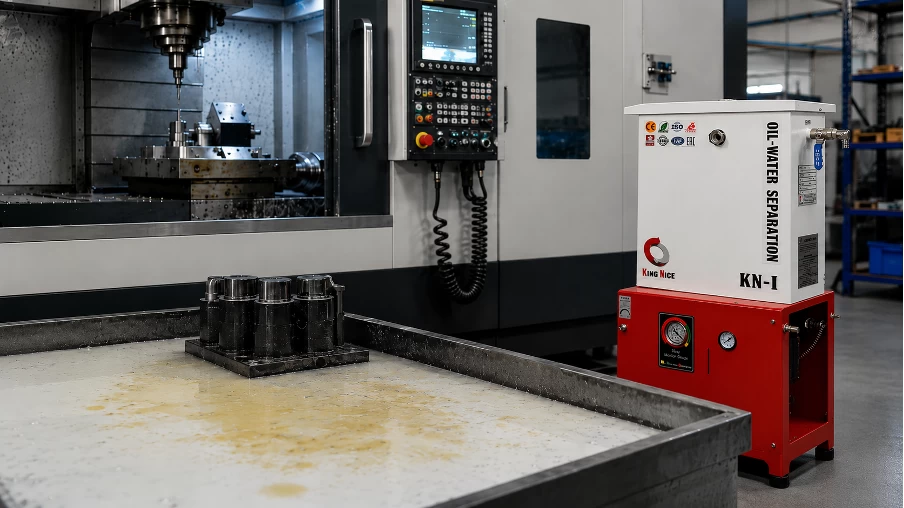
During CNC machining, slideway oil, hydraulic oil, lubricating oil, and grease may gradually enter the coolant tank and form a floating oil layer on the surface. If the oil is not removed regularly, it may contribute to coolant odor and increase the amount of tank cleaning and coolant maintenance required.
An oil-water separator collects contaminated fluid from the coolant surface, separates unwanted oil from reusable coolant, and helps reduce the amount of tramp oil remaining in the tank.
However, floating oil may not be the only contaminant inside a CNC coolant tank. If metal fines, grinding particles, chips, or sludge are also present, additional filtration or sump-cleaning equipment may be required.
This article explains where tramp oil comes from, the common removal methods, how a KingNice oil-water separator works, and what manufacturers should consider when selecting equipment.
Key Takeaways
- Tramp oil commonly comes from slideway lubrication, hydraulic systems, and other machine lubricants.
- Manual removal may be suitable for small and occasional amounts of floating oil.
- An oil-water separator is more suitable when tramp oil continues to accumulate.
- Oil-water separators mainly treat floating oil and cannot replace fine-particle filtration or sump cleaning.
- If tramp oil quickly returns after treatment, the machine should also be inspected for continuing oil leaks.
- Equipment selection should consider the coolant type, tank capacity, oil volume, and other contaminants in the tank.
Where Does Tramp Oil in CNC Coolant Come From?
Tramp oil is unwanted oil that enters the coolant tank from another part of the CNC machine. Common sources include slideway lubrication, hydraulic leaks, spindle or gearbox lubricants, grease, and oil carried into the tank by workpieces or metal chips.
These oils are usually lighter than water-based coolant. When the machine stops and the fluid becomes calmer, the unwanted oil gradually rises and collects on the surface.
If the oil layer remains in the tank for too long, it may affect coolant condition and increase the risk of unpleasant odors. When tramp oil combines with metal fines and sludge, tank cleaning and maintenance may also become more difficult.
Further reading: Why Machine Coolant Smells: Oil Film, Concentration Imbalance, and Sludge Problems
What Are the Common Ways to Remove Tramp Oil?
The suitable method depends on the amount of oil, tank capacity, production schedule, and daily maintenance requirements.
Manual removal
When only a small amount of oil is present, operators may use a scoop, absorbent material, or collection container to remove it. This method does not require additional equipment and may be suitable for occasional light contamination. However, it requires regular manual work and may remove usable coolant together with the waste oil.
Manual cleaning also removes only the oil that has already reached the surface. If slideway or hydraulic oil continues entering the tank, the floating oil will return.
Mechanical surface skimming
Some surface-skimming devices use belts, discs, tubes, or other oil-collecting components to continuously remove oil from the coolant surface. These systems can reduce manual cleaning, but their performance may be affected by changes in liquid level, chip interference, available installation space, and coolant condition.
Using an oil-water separator
An oil-water separator collects the most contaminated fluid from the upper part of the coolant tank and sends the oil-and-coolant mixture into a separation system.
The separated waste oil enters an independent collection area, while coolant that remains suitable for use may be returned to the tank according to site requirements.
Compared with manual removal, an oil-water separator is more suitable for CNC facilities where floating oil is continuously produced, manual cleaning is required too frequently, or coolant loss with waste oil needs to be reduced.
How Does a KingNice Oil-Water Separator Work?
A KingNice oil-water separator uses a pneumatic pump to collect contaminated fluid from the coolant surface and transfer the oil-and-coolant mixture into the separation system.
The mixture passes through KingNice’s patented T.P.M. medium matrix. Small oil droplets gradually combine, rise to the surface, and flow into a separate waste-oil collection area.
Coolant that remains suitable for machining may then be returned to the tank according to site conditions, reducing the amount of usable coolant discharged together with the waste oil.
The separation process is physical and does not require chemical additives. This helps maintain the original coolant concentration and operating condition while reducing waste-fluid handling and unnecessary coolant replenishment.
Learn more about the KingNice Oil-Water Separation and Coolant Purification Solution .
What Are the Main Advantages of KingNice Oil-Water Separators?
Pneumatic operation
KingNice oil-water separators operate with compressed air, reducing the need for an electrical connection beside the coolant tank and making them suitable for CNC machining environments.
No chemical additives
Oil and coolant are separated through a physical process without adding chemicals, helping preserve the coolant’s original operating condition.
Reusable coolant recovery
The separator removes waste oil from the coolant mixture instead of discharging the entire mixture, helping reduce unnecessary coolant loss.
Models for different tank and contamination conditions
CNC machines have different tank capacities, tramp-oil loads, and contamination conditions. The oil-water separator should therefore be selected according to the actual application.
The compact KN-S Oil-Water Separator is suitable for routine floating-oil treatment on CNC lathes, milling machines, and machining centers.
When the coolant contains floating oil together with suspended fines, emulsified contaminants, or other impurities, the KN-PLUS Multi-Function Oil-Water Separation and Purification System may provide a more complete treatment process.
Equipment selection should also consider tank size, the rate of oil accumulation, coolant type, suspended-solid conditions, and expected operating frequency.
Why Is Oil-Water Separation Sometimes Ineffective?
If floating-oil treatment remains ineffective after an oil-water separator has been installed, the problem may be related to the intake position, tank condition, or continuing contamination source.
The intake is not positioned near the surface
Floating oil normally concentrates at the coolant surface. If the intake is placed too deeply, the system may collect too much coolant and not enough oil. The collection position should therefore match the tank design and changes in liquid level.
The oil has not reached the surface
During machining, coolant circulation may temporarily keep unwanted oil dispersed throughout the fluid. If a clear surface layer has not yet formed, the separator may collect more coolant than oil. Allowing the tank to settle after machining may help the oil rise to the surface.
The oil remains mixed throughout the coolant
Oil-water separators work most effectively on unwanted oil that has separated and floated to the surface. If the oil remains dispersed throughout the coolant, surface collection alone may not remove it completely. The coolant concentration, contamination condition, and oil source should then be checked.
Many water-soluble coolants are naturally milky, so coolant appearance alone should not be used to determine whether tramp-oil contamination is present.
Metal fines or sludge are also present
An oil-water separator mainly removes floating oil and cannot replace every type of coolant-treatment equipment.
Metal fines and grinding particles may remain suspended, while larger chips and sludge settle at the bottom of the tank. These contaminants may continue affecting the coolant even after the floating oil has been removed.
Further reading: How to Remove Metal Fines from Machine Coolant
The machine continues to leak oil
An oil-water separator removes oil after it enters the tank, but it cannot repair a leaking hydraulic system, damaged seal, or excessive lubrication.
If floating oil quickly returns after treatment, the slideway lubrication, seals, and hydraulic system should be inspected.
The equipment capacity does not match the oil load
A compact separator may be suitable for routine maintenance but may not keep up with a machine that continuously leaks a large amount of oil.
Tank capacity, tramp-oil volume, machine operating hours, treatment frequency, and available space should all be evaluated before equipment selection.
What Problems Are Commonly Overlooked During Tramp-Oil Treatment?
One common problem is waiting until a thick oil layer or strong odor appears before taking action. Regular removal of small amounts of oil is generally easier than treating a heavily contaminated coolant tank.
Another common mistake is assuming that every coolant problem can be solved with an oil-water separator. Floating oil, suspended particles, and bottom deposits are located in different areas of the tank and require different treatment methods.
| Main coolant-tank problem | Recommended treatment |
|---|---|
| Floating tramp oil | Oil-water separator |
| Suspended metal fines or grinding particles | High-precision coolant filtration system |
| Chips and sludge at the tank bottom | Chip and sludge removal equipment |
| Multiple contaminants | Combined treatment process |
Replacing the coolant without cleaning the bottom of the tank is another common maintenance problem. Old chips, sludge, and contaminated fluid left in the sump may quickly affect the new coolant.
What Equipment Is Needed When Fines or Sludge Are Also Present?
An oil-water separator mainly treats slideway oil, hydraulic oil, and other floating contaminants on the coolant surface. However, oil is not always the only contamination present in a CNC tank.
When metal fines, grinding particles, or other suspended solids continue circulating in the coolant, an oil-water separator alone may not provide complete treatment.
KingNice’s High-Precision Coolant Filtration Systems can be used to remove fine particles and suspended contaminants, helping reduce the amount of debris returning to the machining area.
When chips and sludge have accumulated at the bottom of the tank, chip and sludge removal equipment is required.
The KN-V200 Sludge and Chip Removal System can extract coolant, metal chips, and settled sludge from CNC tanks while supporting the recovery of reusable fluid.
Further reading: Automated Sump Cleaning vs. Manual Cleaning: Which Is More Cost-Effective?
How to Select an Oil-Water Separator for CNC Coolant
Before selecting an oil-water separator, manufacturers should first identify the main contamination problem inside the coolant tank.
If the contamination is concentrated on the surface, such as slideway oil, hydraulic oil, or other floating oil, an oil-water separator may be suitable.
If the coolant also contains metal fines or grinding particles, or if chips and sludge have accumulated at the bottom, additional filtration or cleaning equipment may be required.
Important selection information includes:
- Coolant type
- Tank capacity and liquid-level variation
- Source and amount of tramp oil
- Presence of suspended fines, chips, or sludge
- Daily machine operating hours
- Expected treatment frequency
- Available installation space
- Availability of compressed air
Providing photos of the coolant surface and tank interior can also help the equipment supplier determine whether the main problem is floating oil, suspended particles, or bottom deposits.
Explore the complete KingNice Oil-Water and Coolant Purifying Series .
FAQ
What contaminants can an oil-water separator remove from a CNC coolant tank?
An oil-water separator mainly removes slideway oil, hydraulic oil, lubricating oil, and other floating contaminants. Suspended particles, chips, and sludge require additional filtration or cleaning equipment.
Why does floating oil return after it has been removed?
Floating oil will return if slideway oil, hydraulic oil, grease, or another lubricant continues entering the coolant tank. The contamination source should be inspected while the separator controls the oil already present.
Can an oil-water separator remove oil mixed throughout the coolant?
An oil-water separator works best on oil that has separated and floated to the surface. If the oil remains dispersed throughout the coolant, further evaluation of the coolant condition, concentration, and contamination source may be required.
Can an oil-water separator remove metal fines and sludge?
An oil-water separator mainly removes floating oil. Suspended metal fines require a coolant filtration system, while settled chips and sludge require chip or sump-cleaning equipment.
Can the separated coolant be reused?
The separated coolant may be returned to the machine if its concentration, condition, and operating performance remain suitable for the machining process. The coolant should be checked before reuse.
Conclusion
An oil-water separator is an important part of CNC coolant maintenance. It collects slideway oil, hydraulic oil, and other floating contaminants from the coolant surface and separates the waste oil from reusable coolant.
Manual removal may be sufficient for occasional light contamination. When floating oil continues to accumulate, an oil-water separator provides a more consistent treatment method and helps reduce coolant loss with waste oil.
However, floating oil may not be the only contamination inside the tank. If metal fines, grinding particles, chips, or sludge are also present, high-precision filtration or chip and sludge removal equipment should be added.
Before selecting equipment, manufacturers should confirm the coolant type, tank capacity, oil source, contamination load, and other contaminants present in the tank.
For equipment recommendations, provide the CNC machine type, coolant type, tank capacity, and contamination condition to KingNice. The technical team can then recommend a suitable oil-water separator and coolant-treatment process.
Updated: 2026-09-01
King Nice specializes in oil-water separation and coolant filtration systems for various industrial applications.